Pixocial, the creative force behind AirBrush, one of the world’s leading AI-powered photo editing apps, wanted to scale its Google campaigns to attract users who bring lasting value — not just short-term sign-ups. By integrating Churney’s predictive optimization technology, Pixocial redefined its user acquisition strategy, focusing on users most likely to convert into paying subscribers.
AirBrush set out to grow efficiently on Google, scaling campaigns while ensuring that new users would deliver long-term subscription revenue — not just free trial activations.
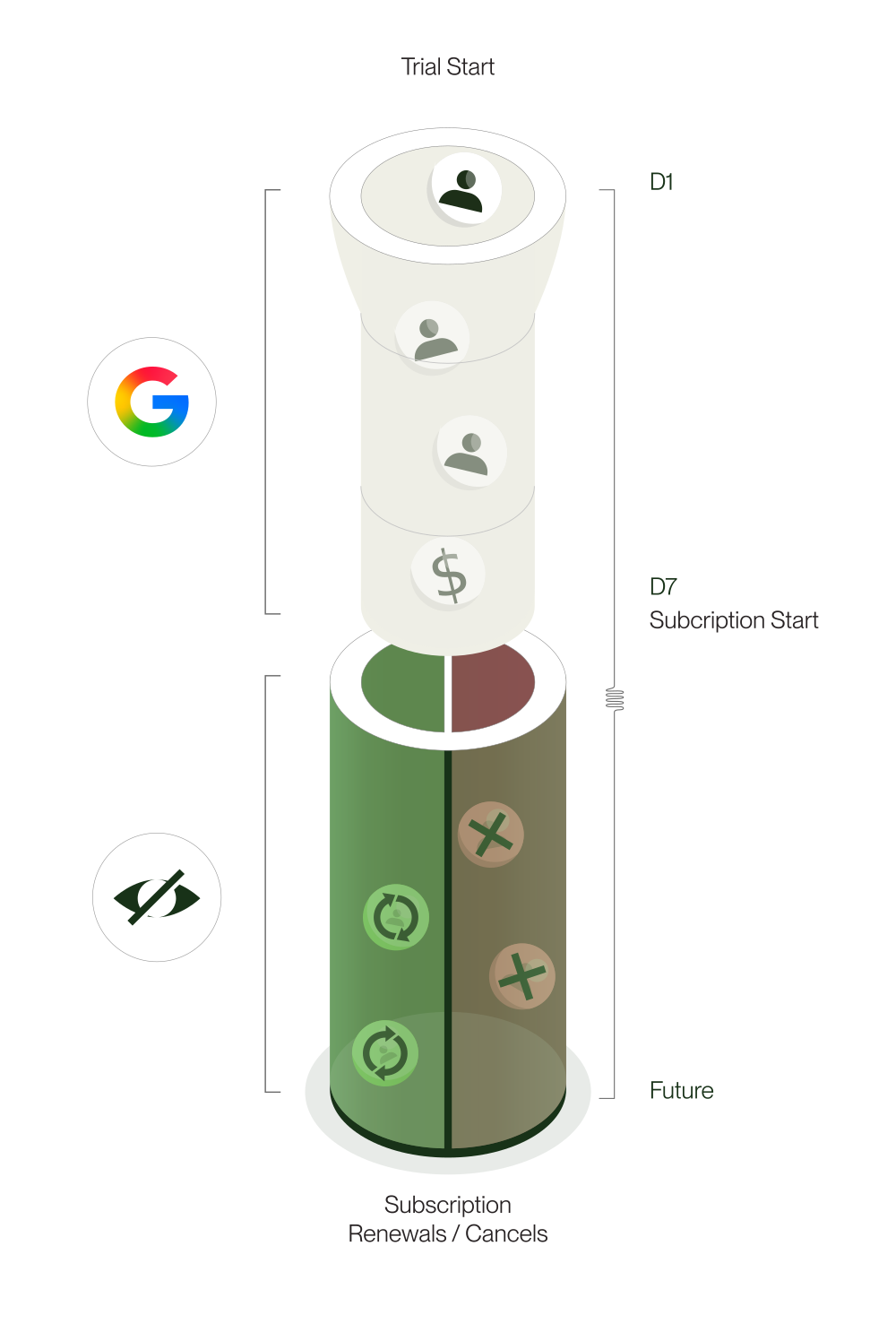
AirBrush’s conversion funnel revolved around a trial-to-paid subscription flow.
However, Google’s default optimization — typically based on a 7-day conversion window — struggled to capture AirBrush’s most valuable users, whose payments often occurred after the trial period.
As a result, campaigns were primarily optimizing for trial starts, rather than users with true revenue potential. This limited Pixocial’s ability to scale profitably based on long-term value.
Churney built a predictive lifetime value (pLTV) model using AirBrush’s historical user data.
The model identified early in-app behaviors and engagement patterns that signaled a user’s likelihood to complete a trial and transition into a paid subscriber.
Using these insights, Churney generated a new pLTV event — a conversion signal sent to Google — enabling campaigns to optimize for users predicted to become valuable subscribers, even before they converted.
This experiment ran for several weeks across Google Web2App campaigns, comparing Churney’s predictive signal against AirBrush’s business-as-usual setup.
By optimizing for predicted long-term value instead of early trials, AirBrush achieved remarkable improvements:
+55% higher Day 14 ROAS
+50% higher trial conversion rate
These results demonstrated that predictive optimization could deliver both stronger returns and higher-quality user acquisition.
Churney’s predictive approach enabled AirBrush to move beyond short-term metrics and optimize for true customer value.
Long-Term Focus: Google’s algorithms targeted users likely to stay, engage, and pay.
Smarter Scaling: AirBrush balanced growth and profitability without sacrificing user quality.
Data-Driven Precision: Predictive modeling turned post-trial uncertainty into actionable insights.
With Churney’s predictive optimization, AirBrush unlocked higher ROAS, stronger conversion rates, and more sustainable growth on Google.
This collaboration shows how forward-looking optimization — powered by predictive data — can transform performance marketing, driving not just installs, but profitable, long-term customer relationships.







Your data warehouse has incredible value. Our causal AI helps unlock it.